Hi all,
Lately I seem to use Twitter more than I use my blog. Keeping up on Twitter is easier than writing entire blog items
. I just added the WP to Twitter plugin to my blog to notice my followers that I blog sometimes. Therefore, if you are interested in my short messages to the world as well ánd want to stay tuned with my progress at this blog, I hereby invite you to follow me: @loedeman.
Happy coding! Cheers!
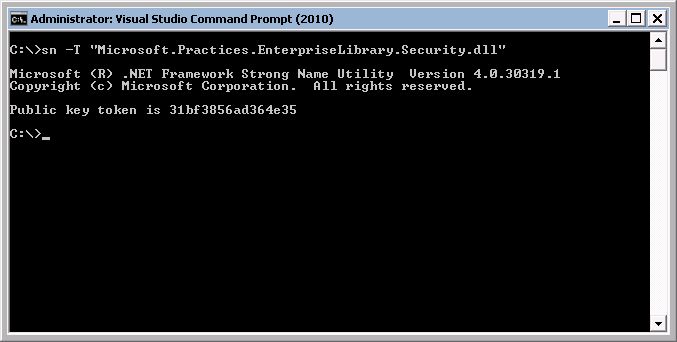
I had to find the public key token for a strongly named assembly in .NET. Searching for a solution, I came along Wriju’s Blog. It appears the answer is very simple: use the .NET Framework tool ‘sn.exe’. Since I do not want to forget about this one, here it is:
- Open the Visual Studio <version reflecting DLL creator/signer> Command Prompt
- Point to the dll’s folder you want to get the public key
- Use the following command: sn –T myDLL.dll

This will give you the public key token. Of course this only works if the assembly is strongly signed
.
It seems everyone I meet is struggling with software versioning. Although it should be fairly easy to deliver consistently versioned software, it almost always appears to be ‘nearly perfect’. And just that ‘nearly’ part makes it crappy and unreliable. However, there is light at the end of the tunnel
: here is a great post about semantic versioning – the way you should do it: http://semver.org/.
It has been a while, but here I am again
… I am currently working on an old Visual Studio 2005 solution. This bugger used to be built by a build server, but that one died about a year ago. Since some bugs really needed fixing, I decided that I would build the project myself for the moment.
Problem was that the solution uses WIX 3.0, and I have WIX 3.5 installed on my machine. After converting the WIX projects I expected the project to build without any problems. Unfortunately, however, WIX crashes with the following error: error LGHT0001: Unable to load DLL ‘winterop.dll’: The specified module could not be found. (Exception from HRESULT: 0x8007007E).
After some searching on the web I found a post (not entirely my problem) with the searched solution: add the installation path of WIX to the Path variable. After this workaround everything works like a charm. Hope this helps you too
!
Happy coding!
It has been a while since I last posted a technical post. I’m sorry, but I am too busy enjoying my work to keep you posted as much as I should.
Just a few days ago I was playing around with YSlow and PageSpeed, two add-ons on Firefox. Both stated my Javascript files were 1) to many and 2) not at all at minimum size.
Searching for an automated way of cleaning up and minifying my Javascript files, I bumped in on JSMin, a Javascript minifier that can be downloaded in C#. Do you hear the term HttpModule in your head already as I did?
When you try to implement JSMin, do consider the fact that your Javascript files will be stripped really rigorous: some of my files did not work anymore after minifying. The reason for this is that Javascript gives you the opportunity to write bad code. To prevent myself from writing rubbish Javascript files that fall apart using JSMin, I now use ‘the tool that hurts feelings’, JSLint. It hints you about bad code and, when obliged to, prevents you from failure when using JSMin afterwards
…
Lucky coding
!